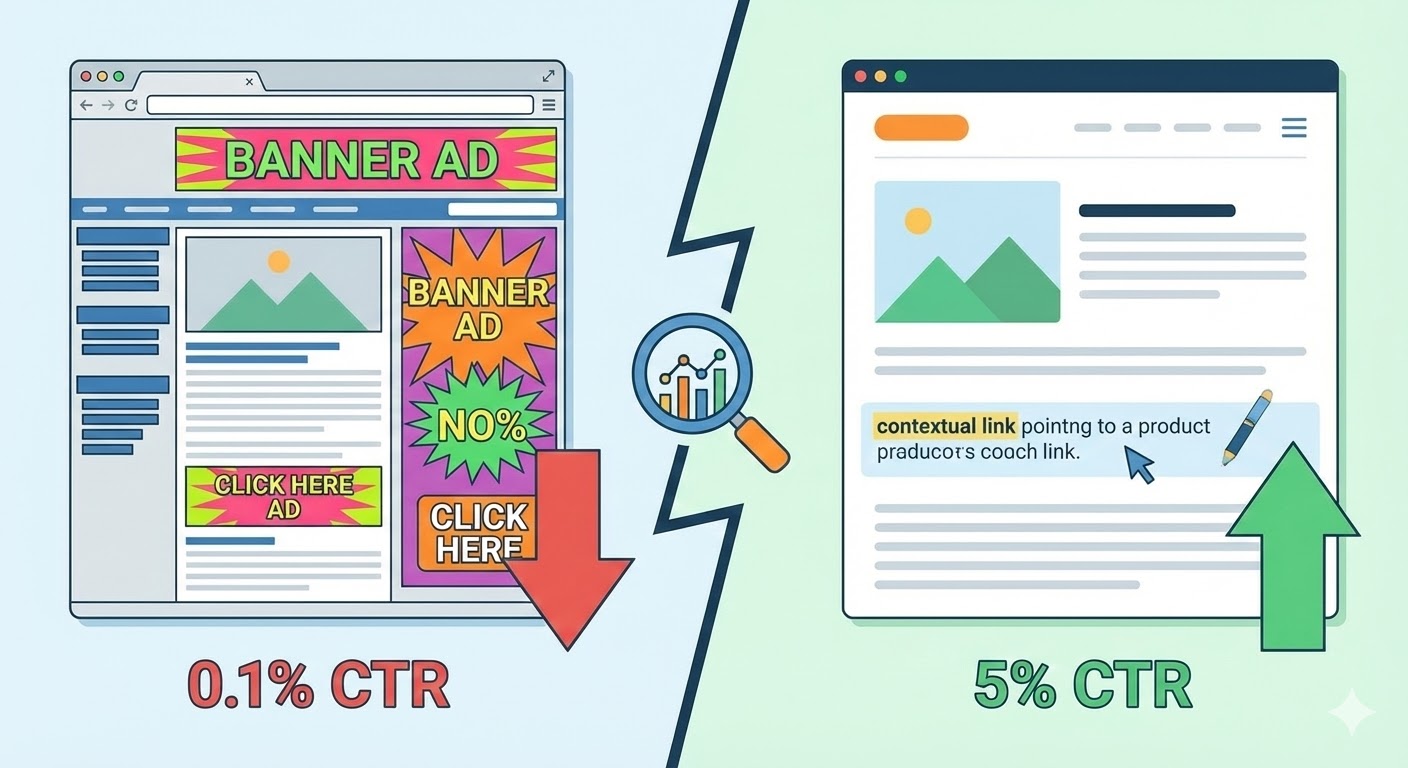
If you look at a blog from 2015, you will notice a familiar pattern: a massive header banner, a sidebar packed with square ads, and maybe a popup or two.
For a long time, this was the standard way to monetize a website. But if you look at the most profitable niche sites and publishers today, the sidebars are completely empty. The banners are gone.
Why? Because the way users browse the internet has fundamentally changed. If you are still relying on banner ads to drive your affiliate revenue, you are likely leaving a massive amount of money on the table. Here is why the shift to contextual linking (in-text links) is the most important change you can make to your monetization strategy.
1. The Reality of “Banner Blindness”
“Banner blindness” is a well-documented psychological phenomenon where web visitors subconsciously ignore anything on a page that looks like an advertisement.
Our brains have been trained to skip over the right sidebar and the top header because we know that space is reserved for ads. We are on the page to read the content, so our eyes stay locked on the text.
- The Banner Reality: The average click-through rate (CTR) for standard display banners is notoriously low, often hovering around 0.1% to 0.5%.
- The Contextual Advantage: In-text links, however, exist exactly where the user is already looking. They don’t look like ads; they look like helpful resources, leading to dramatically higher CTRs.
2. The Rise of Ad Blockers
Over 40% of internet users currently use some form of ad-blocking software.
If your primary affiliate strategy relies on image banners, widgets, or javascript-based ad networks, nearly half of your audience might never even see your offers.
Contextual links bypass this entirely. Because they are native HTML text links embedded naturally inside your paragraphs, ad blockers do not hide them. Your monetization strategy becomes 100% visible to your entire audience.
3. Contextual Links Capture “High Intent”
A banner ad in a sidebar is passive. It hopes a user happens to be interested in web hosting while they are reading an article about gardening.
Contextual links are active. If you are writing a paragraph about the exact soil you use for tomatoes, and you link the words “organic tomato soil” directly to Amazon, the intent is perfectly matched. The user is reading about the problem, and you are immediately linking them to the solution. This relevance is the single biggest driver of affiliate conversions.
How to Transition Your Site (The Smart Way)
If you have hundreds of blog posts, the idea of removing banners and manually finding places to insert text links sounds like a nightmare.
You have two options:
- The Manual Audit: Go through your top 20 most trafficked posts, find relevant keywords, and manually add your affiliate links. This takes time, but it is worth it for your best-performing content.
- The Automated Approach: Most modern publishers use tools to handle this instantly. For example, using a tool like our Auto Affiliate Links plugin, you can simply tell your website: “Every time I mention ‘Bluehost’, turn it into this affiliate link.” The plugin will automatically scan your entire archive and convert your text into high-converting contextual links without you having to open a single old post.
The Bottom Line
Banners are for brand awareness; contextual links are for conversions. By moving your affiliate links out of the sidebar and into the actual sentences your readers are consuming, you build more trust, bypass ad blockers, and ultimately drive higher revenue.